
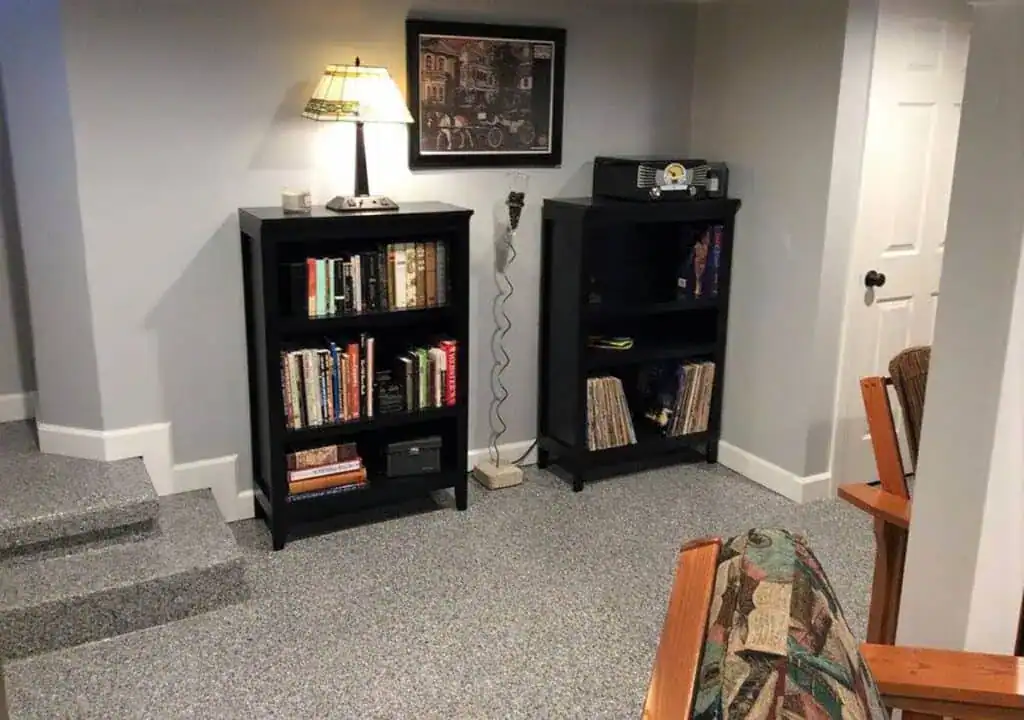
Yes, you can coat a basement floor in Rochester, but only if the slab passes a moisture test and any active cracks are repaired first. A polyaspartic or epoxy coating bonded to a properly prepped basement slab lasts 7 to 15 years. A coating applied over an untested or damp slab usually peels within 1 to 2 years.
That is the short answer. The full answer covers when to coat, when not to coat, which coating works best in a Rochester basement, what it costs, and what to expect during the project. This guide walks through every decision a Rochester homeowner faces.
When a basement floor is worth coating
Three conditions decide it. If any of the three fails, money is better spent on a different fix first.
- The slab passes a moisture test. A calcium chloride or relative humidity probe measures how much water vapor is moving up through the concrete. If the reading is below the coating manufacturer’s threshold, the floor is ready. If the reading is above, mitigation comes first.
- Any active cracks are stable or repairable. Hairline cracks at control joints are normal. Active cracks that are widening, displacing, or weeping water are not. They must be V-grooved, filled with a flexible polyurea, and given time to cure before the coating goes down.
- The basement use case justifies the spend. A finished basement, a workshop, a home gym, or a regularly used storage area all justify a coating. An unfinished damp basement that gets visited twice a year does not.
Anything else, and you are paying for a coating that will fail.
What kills basement coatings in Rochester specifically
Basements behave differently from garages. Garages get heat, sun, and salt from above. Basements get moisture, low temperatures, and pressure from below. Four local factors drive most failures we see in Rochester basements.
Hydrostatic moisture from older slabs
Many Rochester basements, particularly in homes built before 1980 in Brighton, Penfield, Irondequoit, and the city core, sit on slabs poured without modern vapor barriers. Groundwater pressure pushes moisture up through the concrete year-round. A coating bonded to a damp slab loses adhesion within 12 to 24 months and peels in sheets. A calcium chloride or relative humidity probe test before quoting catches this. If the test shows excessive moisture, a vapor-blocking primer or full mitigation is required before any coating goes down. We documented one of these jobs in our North Chili moisture damage case study.
Cracks and slab movement
Basement slabs settle over time. Hairline cracks at control joints are normal and acceptable. Active cracks that are widening, showing displacement, or weeping water are not. A coating spanning an active crack telegraphs the movement to the surface within a year. The coating either tears at the crack or develops a visible bulge. Cracks must be opened with a V-groove, filled with a flexible polyurea, and given full cure time before the coating goes on. Skipping this step guarantees a return service call within 12 months.
Cold concrete and condensation
Rochester basements run cold year-round, often 55 to 60 degrees Fahrenheit even in summer. Warm humid air entering the basement condenses on the cool slab. A coating with poor curing under those conditions traps the condensation and develops blisters from below. Polyaspartic cures correctly down to about 30 degrees Fahrenheit. Epoxy needs at least 50 to 55 degrees during the full cure window, which means basement epoxy installs are seasonal in Rochester or require space heating during cure.
Radon mitigation interaction
A basement floor coating does not stop radon. Radon enters through cracks, sump openings, and floor-wall joints rather than across an intact slab surface. A coating may slightly reduce radon entry by sealing visible surface cracks, but it is not a substitute for a proper radon mitigation system. Homes with elevated radon need a sub-slab depressurization system installed first. The coating goes on top of, and works around, the radon system.
Which coating works in a Rochester basement
Three options cover most residential basements. The choice depends on use case, budget, and how the basement is heated.
- Polyaspartic system. Lasts 12 to 15 years on a properly prepped slab. Cures in cold concrete down to 30 degrees Fahrenheit. Best for finished basements, workshops, home gyms, and basements that experience temperature swings. The most forgiving system for Rochester conditions.
- High-build epoxy with topcoat. Lasts 7 to 10 years on a properly prepped slab. Needs at least 50 degrees Fahrenheit through the full cure window, which means seasonal install timing or supplemental heat. Good for moderate-use basements that stay reliably above 50 degrees year-round.
- Penetrating concrete sealer. Lasts 5 to 7 years before reapplication. Not technically a coating, more of a chemical hardener. Right answer for unfinished storage basements where the slab needs dust control but appearance does not matter.
For a deeper breakdown of how the resin chemistries differ, see our epoxy vs polyaspartic guide. For lifespan expectations across Rochester conditions, see our how long coatings last guide.
When coating a basement is the wrong move
Two situations tell us a homeowner is better off skipping the coating. We turn down both jobs about a dozen times a year. It is the right call.
First, if the slab is failing structurally, not just cosmetically. Heaving, large displacement cracks, or sections of the slab below grade because of poor drainage are not coating problems. Those are foundation or drainage issues that need to be solved first. A coating put down over a failing slab fails when the slab fails. The homeowner pays twice.
Second, if the basement floods periodically. A finished basement that takes water once or twice a year is a candidate for coating only after the source of water is fixed. Coating a regularly flooded basement traps moisture against the slab, accelerates concrete deterioration, and ruins the coating in the first event. The fix is exterior drainage, an interior French drain, or a properly sized sump system, not a floor coating.
What a Rochester basement install costs
A professional basement floor coating in Rochester runs $6 to $9 per square foot installed. The total depends on basement size, prep required, the coating system selected, and whether crack repair or moisture mitigation is needed up front.
Typical project totals at this rate:
- 500 square foot basement: $3,000 to $4,500
- 800 square foot basement: $4,800 to $7,200
- 1,000 square foot basement: $6,000 to $9,000
- 1,200 square foot basement: $7,200 to $10,800
Concrete crack and joint repair add-ons run $300 to $900 depending on scope. Vapor-blocking primer adds to the base cost where slab moisture testing requires it. The on-site assessment locks the final number once the slab is inspected and any prep work is scoped.
For pricing on related coating systems and a full breakdown of Rochester ranges, see our garage floor coating cost page.
What a basement project looks like
A typical Rochester basement coating runs 1 to 3 days from arrival to walkable floor, depending on size and prep needs.
Day one is prep. The crew clears the basement, grinds the slab to open the surface profile, vacuums the dust, repairs any cracks or joints, and runs the moisture test if it has not already been done. Day two is base coat plus chip broadcast if the system uses one. Day three is the topcoat. Polyaspartic systems can sometimes compress days two and three into a single day because of the fast cure. Epoxy systems usually cannot.
Foot traffic returns 24 hours after the topcoat. Heavy items and furniture wait 72 hours. Full chemical resistance reaches maximum at the 7-day mark.
Talk to a Rochester installer who has seen the failures
Garage Floor Coatings Rochester NY has been installing residential coatings across Monroe County since 2018. Basement work is part of our standard scope. Our basement floor coating service page lists the service in detail. We also offer the only polyaspartic system in Rochester backed with a written long-term warranty.
Every basement project starts with a free on-site assessment. We measure slab moisture with a calibrated probe, test bond strength on the existing surface, inspect cracks, and tell you straight whether the slab is ready, what prep is needed, and which coating system fits the use case. We will tell you to skip the project if the answer is skip the project.
Call (585) 880-2481 to schedule a free Rochester basement floor assessment.
Frequently asked questions
Can you coat a basement floor with moisture problems in Rochester?
Yes, but only after a moisture test on the slab. A calcium chloride or relative humidity probe measures how much vapor is moving through the concrete. If the reading is below the coating manufacturer’s threshold, the floor coats normally. If the reading is above, a vapor-blocking primer must be applied first or the project should be deferred until the source of moisture is fixed. Coating a damp Rochester basement slab without testing leads to peeling within 12 to 24 months.
Does basement floor coating reduce radon in a Rochester home?
No. A floor coating may seal small surface cracks, which can slightly reduce radon entry, but it does not stop radon. Radon enters through floor-wall joints, sump openings, and the slab perimeter, not across an intact concrete surface. Homes with elevated radon levels need a sub-slab depressurization system installed first. The floor coating goes on top of and works around the radon system.
How does basement floor coating handle hydrostatic pressure?
Coatings cannot resist active hydrostatic pressure. If groundwater is pushing up through the slab, no surface coating will hold for long. The fix is exterior drainage, an interior French drain, or a sump system to relieve the pressure. After the pressure is relieved and the slab moisture test passes, a polyaspartic or epoxy coating bonds normally.
What is the best coating for a basement floor in Rochester NY?
Polyaspartic is the best choice for finished basements, basement workshops, or basements that experience temperature swings. It cures in cold concrete and lasts 12 to 15 years. High-build epoxy works well for moderate-use basements that stay above 50 degrees Fahrenheit year-round and lasts 7 to 10 years. A penetrating concrete sealer is the right answer for unfinished storage basements where appearance does not matter.
How long does a basement floor coating last in Rochester?
On a properly prepped slab that passed moisture testing, a polyaspartic basement coating lasts 12 to 15 years and a high-build epoxy lasts 7 to 10 years. On a slab that was not moisture-tested or had unrepaired active cracks, both systems typically peel within 1 to 2 years. Slab prep is the single biggest factor in basement coating lifespan.
How much does basement floor coating cost in Rochester NY?
A professional basement floor coating in Rochester runs $6 to $9 per square foot installed. A 500 square foot basement typically costs $3,000 to $4,500. An 800 square foot basement runs $4,800 to $7,200. A 1,000 square foot basement runs $6,000 to $9,000. Concrete crack and joint repair add-ons run $300 to $900 depending on scope. Vapor-blocking primer adds to the base cost where slab moisture testing requires it.