
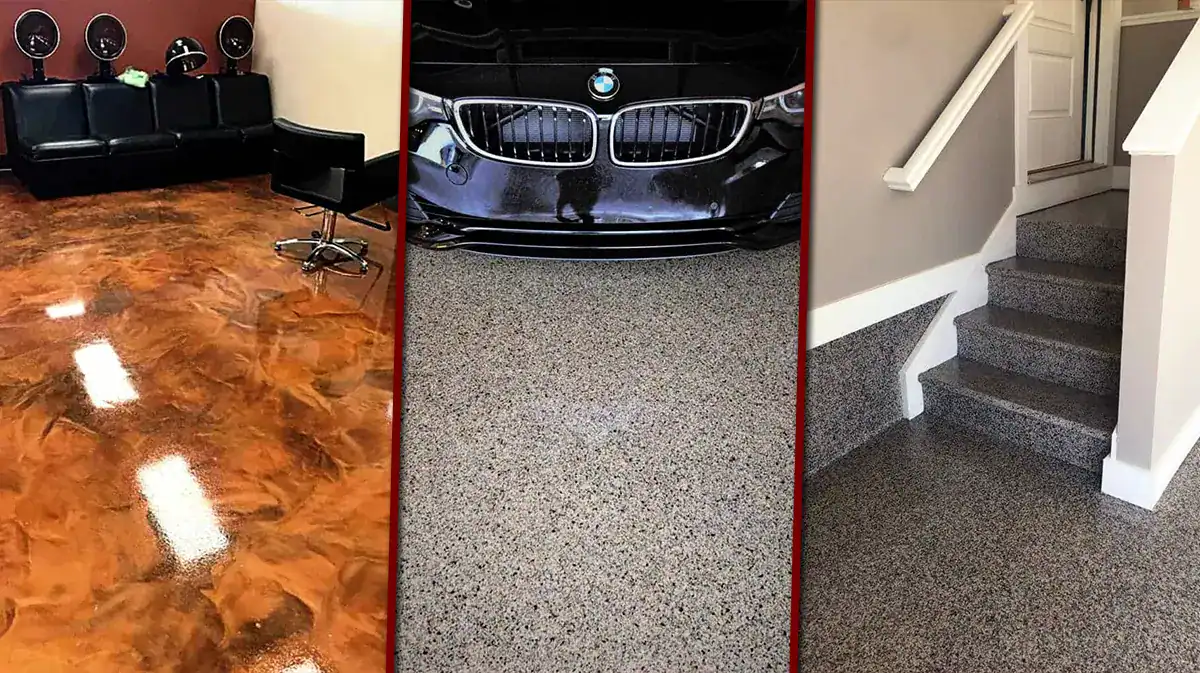
Epoxy vs Polyaspartic Garage Floor Coatings in Rochester NY: Which Lasts Longer?
Polyaspartic coatings outlast standalone epoxy in Rochester NY by 5 to 10 years because they resist UV fading, cure in any temperature, and bond tighter against moisture. But the best garage floor coating systems use both: a 100% solids epoxy base with a polyaspartic topcoat. Here is how the two compare and why the combination matters for Western NY garages.
The Short Answer
If you are choosing between a single coat of epoxy and a single coat of polyaspartic, polyaspartic wins on durability every time. But professional coating systems in Rochester do not force you to choose one or the other. The strongest systems layer epoxy as the bonding foundation and polyaspartic as the protective topcoat. That combination gives you the deep concrete penetration of epoxy with the chemical resistance and UV stability of polyaspartic.
Most “epoxy vs polyaspartic” comparisons online treat them as competing products. In practice, they are complementary layers in a single system.
What Is Epoxy Floor Coating?
Epoxy is a two part resin system (resin plus hardener) that chemically bonds to concrete. When mixed and applied correctly, it creates a rigid, high strength surface that resists compression, abrasion, and chemical spills.
Key characteristics of epoxy:
– Requires a minimum 50 degrees Fahrenheit to cure properly
– Full cure time: 24 to 72 hours depending on temperature and humidity
– Thickness: 100% solids epoxy applies at 10 to 20 mils per coat
– Excellent adhesion to properly prepared concrete
– Susceptible to UV yellowing if used as a topcoat without protection
– Lower material cost per square foot than polyaspartic
In Rochester, the temperature requirement matters. A garage in January might sit at 35 degrees, well below the cure threshold. This is why timing and system design matter more here than in warmer climates.
For a full breakdown of our epoxy systems, visit our [epoxy garage floor coating page].
What Is Polyaspartic Floor Coating?
Polyaspartic is a type of polyurea coating developed as a faster curing, more flexible alternative to traditional epoxy. It was originally designed for bridge deck coatings in extreme weather, which makes it well suited for Rochester conditions.
Key characteristics of polyaspartic:
– Cures in 2 to 6 hours regardless of temperature
– Can be applied in temperatures as low as 30 degrees Fahrenheit
– UV stable, will not yellow or fade over time
– Higher abrasion and chemical resistance than epoxy alone
– More flexible, which helps it handle the expansion and contraction cycles Rochester concrete goes through every winter
– Higher material cost per square foot than epoxy
The flexibility point is critical in our climate. Rochester concrete expands and contracts through freeze and thaw cycles from November through March. A rigid coating that cannot flex with the slab will eventually crack and delaminate. Polyaspartic handles that movement.
Learn more about our [polyaspartic floor coating systems].
Head to Head Comparison
| Feature | Epoxy | Polyaspartic |
|——————————————————–|
| Cure time | 24 to 72 hours | 2 to 6 hours |
| Minimum application temp | 50F | 30F |
| UV resistance | Low (yellows over time) | High (color stable) |
| Abrasion resistance | Good | Excellent |
| Chemical resistance | Good | Excellent |
| Flexibility | Rigid | Semi flexible |
| Cost per sq ft | Lower | Higher |
| Lifespan (standalone) | 5 to 10 years | 10 to 20 years |
| Best used as | Base coat / primer | Mid coat or topcoat |
Why Rochester Garages Need Both
A garage floor in Greece, Penfield, or Henrietta deals with conditions that most coating comparisons do not account for:
**Road salt exposure.** Every car that pulls into a Rochester garage from November through April carries road salt, calcium chloride, and brine solution on its tires. These chemicals eat through thin coatings and single layer epoxy within 2 to 3 seasons.
**Freeze and thaw cycling.** Rochester averages 100+ freeze and thaw cycles per winter. Each cycle pushes moisture into concrete pores, expands, and contracts. A coating that cannot flex with this movement will crack and peel.
**Moisture vapor transmission.** Many Rochester homes sit on clay heavy soil with poor drainage. Moisture vapor pushes up through the concrete slab constantly. A coating system without proper moisture mitigation will bubble and delaminate within the first year.
**Hot tire pickup.** In summer, tires reach 200+ degrees on Rochester roads. A thin or improperly cured coating will soften and peel when hot tires sit on it overnight. This is the most common failure mode for DIY and one day coatings.
The solution is a multi layer system: diamond grind the concrete surface to open the pores, apply a 100% solids epoxy primer that penetrates deep into the slab, broadcast a full chip or metallic layer for thickness and aesthetics, then seal everything with a polyaspartic topcoat that handles UV, chemicals, and flex.
That is the system we install. It is not a one day shortcut. It takes 2 to 3 days because each layer needs proper cure time before the next goes down. The result is a floor that lasts 15 to 20 years instead of 2 to 3.
Read more about [why one day coating systems fail].
What About DIY Epoxy Kits?
The epoxy kits sold at hardware stores in Rochester are water based epoxy, typically 40% to 60% solids. They apply at 3 to 5 mils thick. For comparison, our base coat alone goes down at 10 to 20 mils, and the full system exceeds 35 mils.
Common failures with DIY kits in Rochester:
– Peeling within 6 to 12 months due to inadequate surface prep (no diamond grinding)
– Hot tire pickup because the coating is too thin to resist heat transfer
– Yellowing within one summer of UV exposure through garage windows
– Bubbling from moisture vapor that was not tested or mitigated before application
A professional system costs more upfront. But replacing a failed DIY coating costs more than doing it right the first time, because the old coating has to be fully removed before a new system can go down. That removal adds $300 to $900 to the project depending on the garage size and how badly the old coating adhered.
For current pricing on professional systems, see our [epoxy flooring cost guide for Rochester NY].
How to Choose the Right System for Your Garage
For most residential garages in the Rochester area, we recommend the full multi layer system:
1. Surface preparation: Diamond grinding to CSP 3 profile (not acid etching, which does not open pores enough for proper adhesion in our climate)
2. Moisture test: Calcium chloride test or relative humidity probe to check vapor transmission before any coating goes down
3. Primer: 100% solids epoxy at 10+ mils
4. Broadcast layer: Full chip, metallic, or quartz for thickness and slip resistance
5. Topcoat: Polyaspartic at 5 to 8 mils for UV protection, chemical resistance, and flexibility
This system works for 2 car garages, 3 car garages, and oversized workshop spaces. For commercial or industrial applications with heavier traffic, we adjust the topcoat thickness and chemical resistance rating.
Visit our [residential garage floor coating page] for more on what is included.
Get a Garage Floor That Lasts Through Rochester Winters
If your garage floor is cracked, peeling, or stained, a professional coating system will fix it permanently. We install epoxy and polyaspartic systems built specifically for Western NY conditions. Every project starts with diamond grinding and a moisture test, because the prep is what makes the coating last.
Call (585) 880-2481 or [request a free estimate] to get started.
Frequently Asked Questions
Is polyaspartic better than epoxy for garage floors?
Polyaspartic is better as a topcoat because it resists UV, chemicals, and temperature swings. But epoxy is better as a base coat because it bonds deeper into concrete. The best systems use both together.
How long does epoxy last on a garage floor in Rochester?
Standalone epoxy lasts 5 to 10 years in Rochester conditions. A multi layer system with an epoxy base and polyaspartic topcoat lasts 15 to 20 years with proper surface preparation.
Can you apply polyaspartic in cold weather?
Yes. Polyaspartic cures in temperatures as low as 30 degrees Fahrenheit, making it ideal for Rochester installations in late fall and early spring when epoxy alone cannot cure properly.
Why do garage floor coatings peel in Rochester?
The most common causes are inadequate surface preparation (no diamond grinding), moisture vapor not tested before application, and coatings that are too thin to handle freeze and thaw cycling and road salt exposure.
How much does a professional garage floor coating cost in Rochester NY?
A professional multi layer system for a 2 car garage in Rochester typically costs $2,400 to $3,800 depending on concrete condition, coating system, and finish type. See our full [pricing guide] for details.
Get a Garage Floor That Lasts Through Rochester Winters
If your garage floor is cracked, peeling, or stained, a professional coating system will fix it permanently. We install epoxy and polyaspartic systems built specifically for Western NY conditions. Every project starts with diamond grinding and a moisture test, because the prep is what makes the coating last.
Call (585) 880-2481 or [request a free estimate] to get started.