
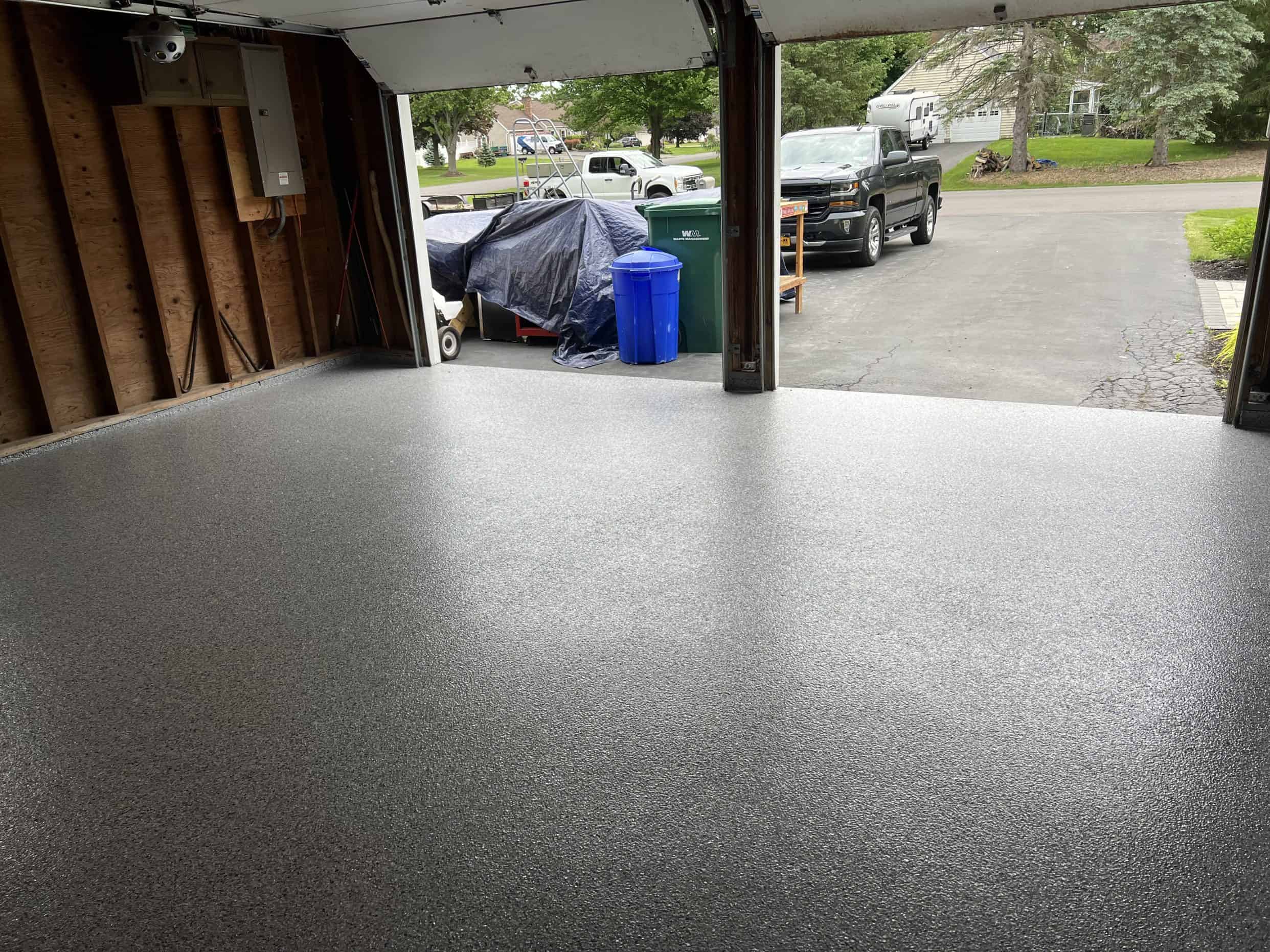
A professionally installed polyaspartic garage floor coating lasts 15 to 20 years in Rochester. A high-build epoxy system lasts 5 to 10 years. A DIY epoxy kit from a big-box store lasts 1 to 3 years before peeling, especially in homes that park cars driven on salted Monroe County roads.
That is the short answer. The longer answer depends on which coating you pick, how the concrete was prepped, how the floor is used, and how Rochester weather treats it. This guide walks through every variable so you can budget realistically and avoid paying twice.
Lifespan by coating system
The system is the single biggest factor. A coating is only as durable as its weakest layer, and the resin chemistry decides how it handles UV, road salt, freeze-thaw cycling, and hot tire pickup. Here is what each system delivers in Rochester conditions, assuming a professional install with proper concrete prep.
DIY epoxy kit (1 part). Typical Rochester lifespan 1 to 3 years. Best use case: light foot traffic only. Common failure mode: peels at hot tire contact points within 12 months.
Single layer commercial epoxy. Typical Rochester lifespan 3 to 5 years. Best use case: low traffic residential. Common failure mode: yellowing, hot tire pickup, edge chipping.
High-build epoxy with topcoat. Typical Rochester lifespan 5 to 10 years. Best use case: daily driver garages. Common failure mode: wear at tire paths, eventual UV chalking near doors.
Full polyaspartic system. Typical Rochester lifespan 15 to 20 years. Best use case: daily driver, heavy use, salt exposure. Common failure mode: slow gloss reduction at year 15 and beyond.
Polyaspartic with chip broadcast. Typical Rochester lifespan 15 to 20 years. Best use case: all residential, most commercial. Common failure mode: same as full polyaspartic, with better hide on minor wear.
Skip the prep, and every range above collapses by 50 to 70 percent regardless of which resin you bought.
What kills coatings in Rochester specifically
Rochester is harder on garage floors than most of the country. A coating that lasts 12 years in Phoenix may peel in 4 years on the same brand of car parked in Brighton. Four local factors drive that gap.
Road salt and brine
Monroe County and the New York State DOT use a brine pre-treatment plus rock salt during winter storms. Salted slush drips off vehicles into the garage and sits on the floor. Chloride ions migrate into untreated or DIY coatings within 18 months and lift the bond from below. Polyaspartic resists this. Single-part DIY epoxy does not.
Freeze-thaw cycling
Rochester sees roughly 90 freeze-thaw cycles per winter according to NOAA climate data for the western New York corridor. Concrete expands and contracts with each cycle. A coating that does not flex with the slab cracks at the joint, then peels outward from the crack. Polyaspartic remains flexible at temperatures down to negative 30 degrees Fahrenheit. Epoxy stiffens and becomes brittle below 40.
Hot tire pickup
A Rochester car driven 15 miles on a 90 degree July day comes home with tire surface temperatures near 160 degrees. A soft coating, especially DIY epoxy, plasticizes under that heat and bonds to the rubber. When the car backs out the next day, the coating lifts off the concrete in tire-shaped patches. This failure is almost exclusive to under-cured or under-spec systems.
Slab moisture in older homes
Many Rochester garages, particularly in older Brighton, Webster, and Penfield homes, sit on slabs poured without modern vapor barriers. Hydrostatic moisture pushes up through the concrete and lifts coatings from the back. A proper installer tests slab moisture with a calcium chloride or relative humidity probe before quoting. If the test shows excessive moisture, a vapor-blocking primer is non-negotiable. We documented one of these jobs in our North Chili moisture damage case study.
Signs your coating is failing
The earlier you catch failure, the cheaper the fix. A localized lift is a touch-up. A floor-wide failure is a full strip and recoat, which costs more than the original install in most cases. Watch for these:
- Hairline cracks running from the slab control joints out into the coating field
- Bubbles or blisters under the coating, often visible only at certain angles in raking light
- Tire-shaped discoloration or lift at the parking spots
- Edge curling along the perimeter of the floor or around drains
- Loss of gloss to a chalky or yellowed appearance, especially within 6 feet of the garage door
- Sticky or tacky spots that never fully cure
- Powder or dust appearing after light foot traffic
Three or more of these together usually mean the coating has reached end of useful life.
How to extend a coating’s life in Rochester
Lifespan is partly product, partly install, partly maintenance. The maintenance side is the part homeowners control.
- Sweep weekly. Sand and rock salt are abrasive. Loose grit acts like sandpaper under tires.
- Rinse after winter. A simple hose-down in late March removes residual chloride. Use a mild pH-neutral cleaner, never a degreaser meant for raw concrete.
- Fix oil drips within 48 hours. Gasoline and motor oil do not damage modern polyaspartic, but extended pooling will discolor older epoxy.
- Use a walk-off mat at the entry door. Tracked-in salt is the single biggest cause of premature wear we see at year 5 inspections.
- Park hot cars on a fender mat in summer. Cheap insurance against hot tire pickup, especially on epoxy systems.
- Recoat the topcoat every 8 to 10 years on epoxy systems. The topcoat is sacrificial. Catching it before the underlying color coat is exposed extends total system life by 5 to 7 years.
A polyaspartic system installed correctly does not need a recoat in the warranty window. An epoxy system usually does.
When to recoat versus replace
Two questions decide it.
First, has the coating lost adhesion to the concrete in more than 10 percent of the floor area? Tap suspect areas with a screwdriver handle. A hollow drum sound means the bond is gone in that spot. If 10 percent or more drums hollow, the floor needs a full strip and recoat. Patching will fail again within a year.
Second, has the original color coat been worn through? If the underlying gray concrete is visible in tire paths, the topcoat sacrificial layer was lost too long ago and recoating will not adhere properly to the worn base. Strip and reinstall is the only reliable fix.
If the answer to both questions is no, a topcoat refresh is the right move. Budget 30 to 50 percent of the original install cost. If the answer to either is yes, plan for a full reinstall and budget the same range you would for a new floor.
What this means for your decision
If you plan to live in your Rochester home for 5 years or less, a quality epoxy system is fine. The math works out, and you will not be the one paying for the recoat.
If you plan to stay 10 years or more, polyaspartic almost always wins on total cost of ownership despite the higher upfront price. Two epoxy installs over 15 years cost more than one polyaspartic install that lasts the entire window.
If your garage sits over a moisture-prone slab, no system will last unless the moisture is addressed first. That diagnosis happens during the on-site quote, not after the install.
For a deeper breakdown of which resin chemistry suits your priorities, see our epoxy vs polyaspartic guide. For typical Rochester pricing on each, the garage floor coating cost page shows the 2026 ranges Noah quotes.
Talk to a Rochester installer who has seen the failures
Garage Floor Coatings Rochester NY has been installing coatings across Monroe County since 2018. We have inspected and replaced more failed DIY and big-box installs than any other contractor in the Rochester market. We also offer the only polyaspartic system in Rochester backed with a written long-term warranty.
If you are not sure how much life is left in your current floor, schedule a free on-site assessment. We will measure slab moisture, test bond strength, and tell you straight whether you need a topcoat refresh or a full reinstall.
Call (585) 880-2481 to schedule a free Rochester garage floor assessment.